

Becoming the Author
Self Authorship III: The Courage to Choose Yourself

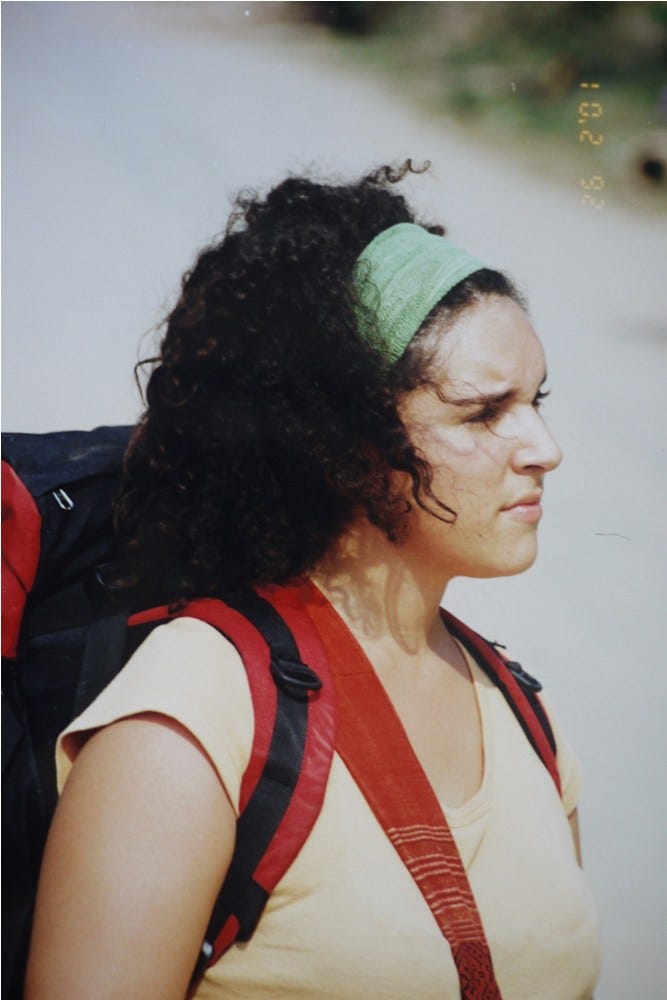
EVER SINCE I WAS FIFTEEN YEARS OLD, I knew I would travel the world. At the clothing store where I worked part-time after school, I stood at the empty till on my Thursday night shift and wrote lists of all the countries I would one day visit. When I imagined myself with a backpack strapped on, standing in some unfamiliar place, I felt a warm rush of electricity—the tingles—cascade from the top of my head like a shower across my body. It felt as if some higher power was acknowledging the rightness of my unorthodox decision in a non-verbal language.
My yearning to explore the world was shaped by my father’s travel tales of hitchhiking to India from Europe and walking across Iran, and by the film, Baraka. I imagined myself in the morning sunlight rising over Borobudur’s stone bells and watching the silhouettes of Nepalese hawkers in the dawn’s first rays in Durbar Square. I hungered to know the world and to find myself in it, to be pushed in ways that tested my comfort, and to grow in ways that the familiar could not so easily catalyze.
Finally, at eighteen, just after high school graduation, my best friend and I set off to backpack across Asia for a year. We gorged ourselves on banana pancakes across Southeast Asia, battled cockroaches in the bellies of ships and on rickety Indonesian buses, and learned how to pick nits out of our hair in Darjeeling. That year of backpacking changed the course of my life forever. And so, in the eleventh month of our trip, just a month shy of our long-haul return home, when I felt right down to my bones that there was no way in hell I was going back (yet), I sensed the gravity of such an off-script choice: the disappointment of friends and family, my first love who wrote me an email and called me “a fucking tourist,” and the courage—or insanity—of heading off to South Korea to illegally teach on a tourist visa with, honest to God, twenty dollars to my name.
There is something powerful about being so young and naïve that you risk everything to take the leap, and something terrifying about initiating yourself into adulthood in a world where you are responsible for your choices, mistakes, and failures. I knew that my decision would break my mother’s heart and that I would have to develop a thick skin for the naysaying I would encounter from folks who insisted that if I didn’t get a college education, I’d be a broke fool. I’ve heard it all.
When you choose to become the author of your life, you quickly learn that walking your most authentic path will require you to disappoint someone in order to remain true to yourself.
What It Means to Become the Author
Self-authorship is the lifelong practise of initiating oneself into a truer kind of adulthood: the decision to live from a place of honesty, consciousness, and authenticity. It is the choice to become aware of the narratives that shape our identity and to root out the harmful scripts that keep us disconnected from our highest selves.
It is the work of mapping bloodlines, storylines, inheritance, and the pressures that culture, family, and history place upon authentic self-expression. It is the journey of putting down the weapon in the battle of ancestral stories and picking up the pen to write a new story for yourself and your descendants.
We are all born into particular cultural, ethnic, and familial burdens, and equally endowed with their blessings. Our stories can be beautiful and life-affirming or heavy and outdated.
If we unconsciously inherit practices, beliefs, and expectations without question, we also inherit wounds, limitations, and unresolved wars. We live according to a program, a script, predetermined borders of the self.
Becoming the author of your life, then, is the practice of returning home to yourself through a devotion to storytelling, ancestral healing, and the inner knowing that existed long before you had language for it—the part of you that always sensed what kind of life would make you feel most alive. It is following your internal compass at the expense of outer expectations.
Self-authorship is not always a life of boarding passes, reinvention, and brave decisions. Sometimes it is simply saying no when people expect yes. It looks like changing your mind. It looks like grieving identities that no longer fit. It looks like disappointing others in order to stop abandoning yourself. It is a commitment to living your best self.
At its core, self authorship is about taking responsibility for your life and shaping who you become to align with your deepest truth.
Every life is authored by something: fear, shame, trauma, tradition, desire, survival, love.
The question is whether the story you are living feels like one you consciously created or unconsciously inherited.

Journal Prompts for Further Exploration
What dream, longing, or instinct have you repeatedly silenced because it felt impractical, selfish, or frightening?
Whose approval are you still unconsciously seeking before allowing yourself to fully live?
If nobody could judge your choices, what kind of life would you begin building?
What would it mean to stop abandoning yourself in small ways?
What is one decision your future self may thank you for making now?
Sacred Assignment
Complete the following sentences without overthinking:
Good daughters are…
Women like me should…
People in my culture do not…
Success means…
Love requires…
Safety means…
Freedom feels like…
Then ask yourself:
Which of these beliefs are truly mine?
Which were inherited?
Which are keeping me small?
Do the exercise again, but change the answers to the ones you want to live in the world and not the expectations that have been placed on you.
My friends, this concludes the three-part Self Authorship Series. Did something resonate with you? Did you try a journal prompt? Are you feeling curious about digging through your family and inner archives for clues on your self authorship journey? I’d love to hear from you in the comments or messages.
Here are parts I and II incase you missed them.


With love,
Yamuna x