

Between Worlds
On becoming the kind of mother I once misunderstood

BEFORE I BECAME A MAMA, I was a long-time backpacker, drifting between countries, sometimes teaching English to stretch my dollars, doing almost anything to avoid ending up back in my hometown. My dad used to call it the ABC plan: Anywhere But Calgary. It wasn’t that I hated where I was born; it just never matched who I felt like on the inside. Once I started travelling, I began collecting pieces of myself in unfamiliar places that often felt more like home than the city where I spent the first eighteen years of my life.
It wasn’t until I travelled to India as an adult and encountered my South Indian mother’s culture without the immigrant-in-Canada filter that I found the language for the sense of marginality I had felt my whole life. Suddenly, I was immersed in a world that felt like my mother: the intense song of Tamil, the soft rolls of flesh on my back I had inherited and spent years resisting, the fragrant curries burying themselves into the walls of homes and returning later in our sweat. It felt like finding my tribe, reclaiming the parts of myself that had been left behind by the early rejection of my foreign roots.

I grew up mostly thinking that my Indian mom was backwards, out of touch with modern culture, too conservative for the country I was growing up in, and I rebelled against her rules at every chance I got. When my parents separated at twelve, I thought I gained the upper hand because I could easily outsmart my mom and felt the superiority of being born in a culture in which her accent revealed her as a visitor. I have never known a life without the pull of the old culture tightening the noose on my self-expression in the place where I should’ve felt free.
From a young age, I learnt how to perform the version of myself each room expected—how to anesthetize the wild in me in sparkling traditional costumes that hid my true identity. There was the version of me who snuck into bars at fifteen and dated criminally older men, and the other one that donned a sari in a room of Tamilians, bangles clinking while I served juice to the elders. It was like taking one jacket off and putting on another, interchangeable layers of my multiplicity.
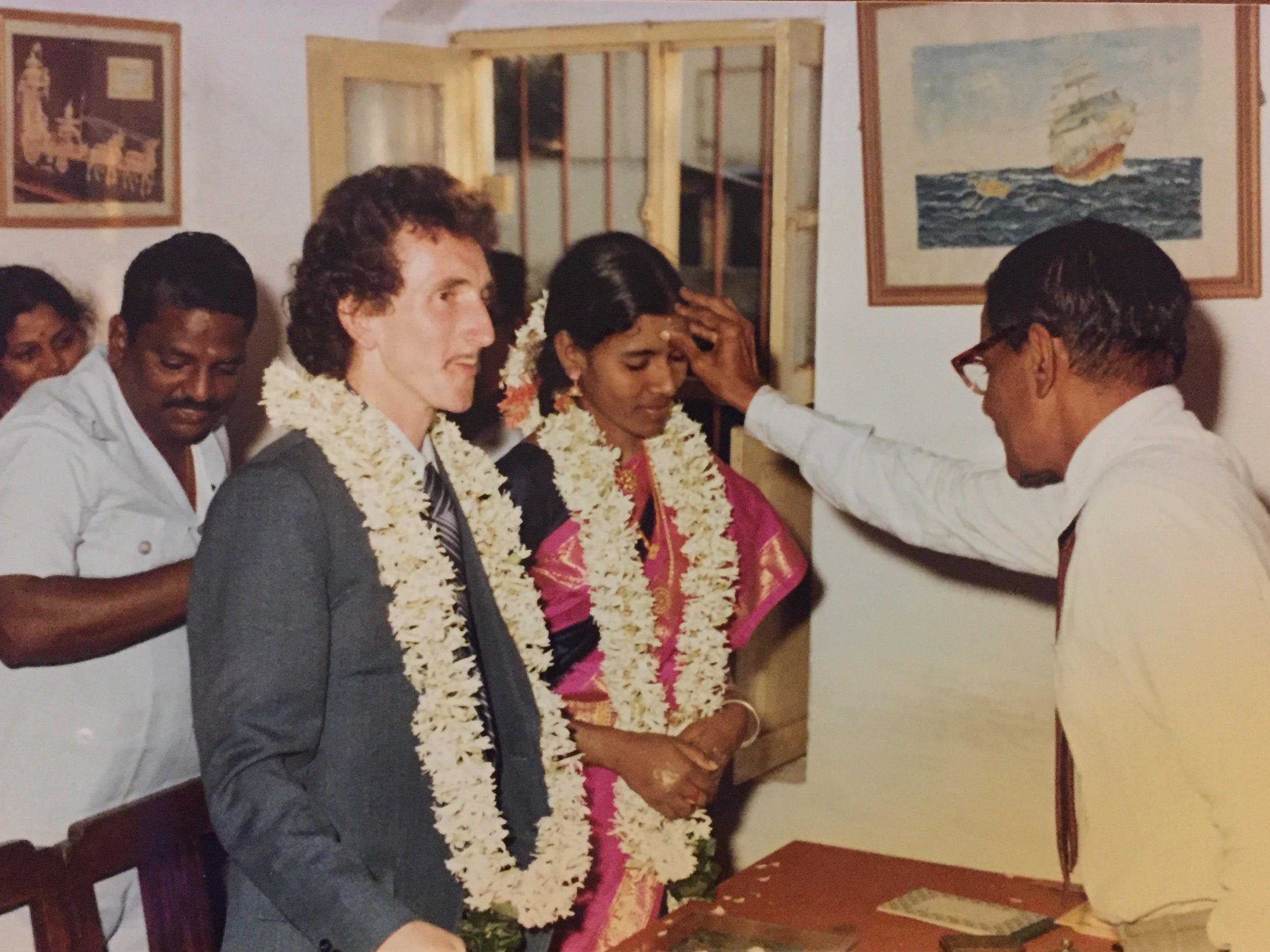
It was my Scottish father, born in Dumbarton in the early 50’s, who left home at 18 to travel and live around the world. The story goes that he bought two broken trucks in a farmer’s field and built one working vehicle out of them (he was a mechanic). He drove it to Europe, lived in Germany, overlanded to India via Afghanistan, walked across Iran, travelled on buses in Pakistan and got stuck in the desert in a broken-down train in India, where he ate some mysterious food that made him so sick that he claims he was never the same again. Eventually, he immigrated to Canada in the 70’s and began regularly travelling to India to study classical music, where he met my mom in a tea shop. After a short courtship and a year-long absence, he returned to marry her in a simple civil ceremony, which resulted in half of her family disowning her.
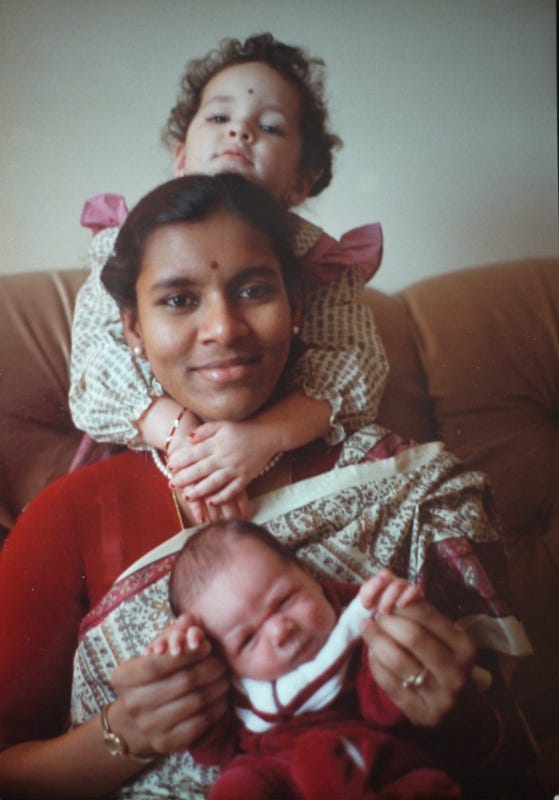
Although I visited Scotland several times in my younger life, the dominant culture in my home was Indian. And since my amma was closer to her family than my dad was to his, our connection to our roots followed theirs. When I finally spent time as an adult in India, in a culture where self-expression is often crippled for social approval, I began to see her particular kind of courage. Context changes everything, and looking at her through the lens of an immigrant single mom, raising two children in a culture that she too was learning, navigating the shame of being a divorced woman, and living in so much goddamn snow for most of the year, is an unseen kind of revolutionary.
I always thought I had inherited my bravery for new worlds from my father, but now I realize they each have their own version of stepping into the uncharted.
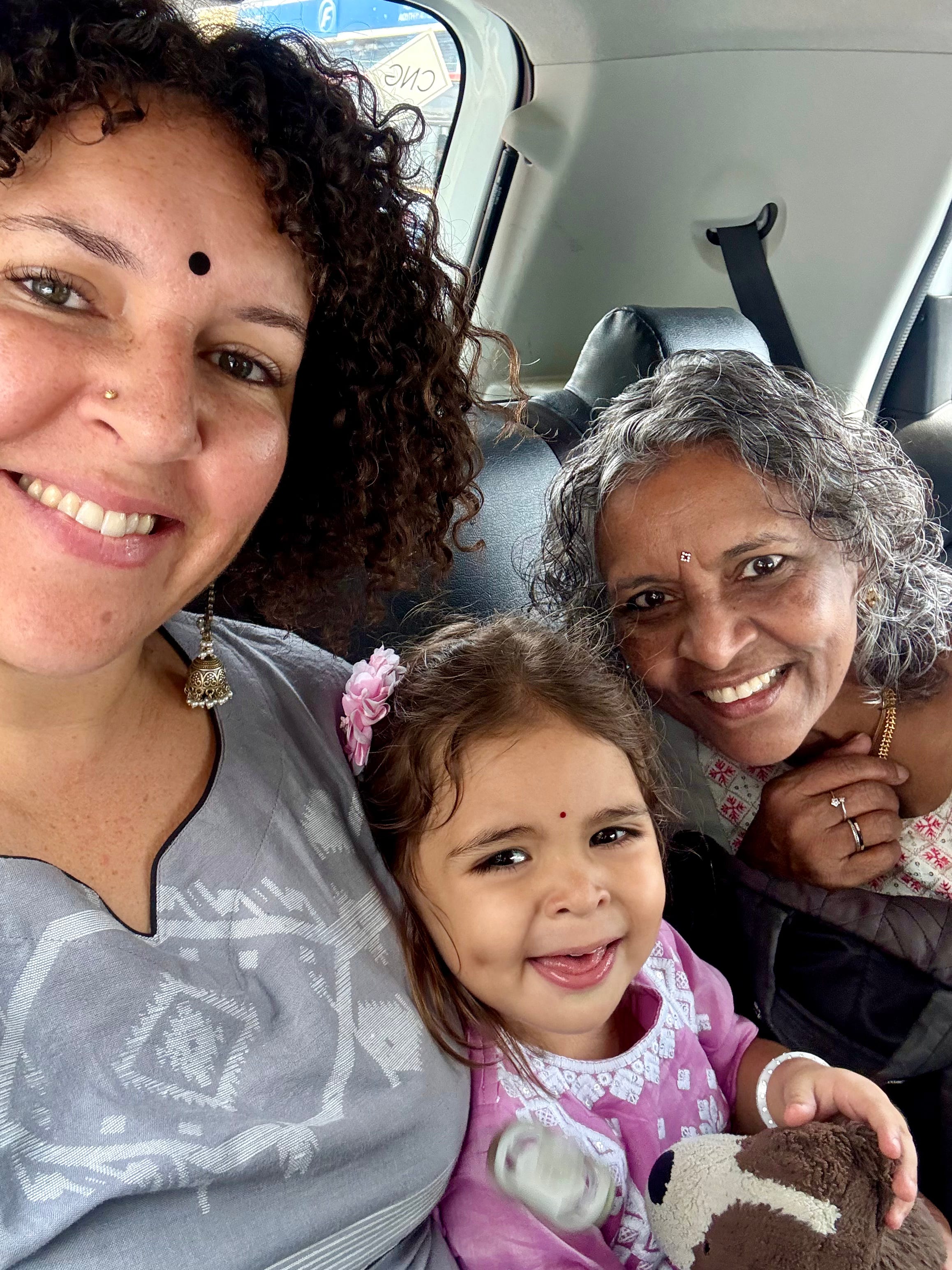
THIS ALL MEANS SO MUCH MORE to me now as I navigate separation, co-parenting and expatriate life as a mama to my Mexican daughter in the mountains of Jalisco. I now know what it feels like to be the newcomer, the outsider, the not-quite-local. No matter how good I am at speaking the language, moving with ease in the market, and getting the jokes, it isn’t the whole picture of who I am. I question whether this is where I truly want to live now that the dream is gone, because it was the only reason I came in the first place. I wonder if my mom ever wanted to leave the hustle of Canada behind for the familiarity of tropical streets fragranced with coconut, jasmine and curry. Where women gathered in shaded corners and walked circles on Chennai rooftops in their long cotton nightgowns.

Like my mother before me, I live between worlds and versions of myself. All of them real, all of them me. I am from a lineage of immigrants who chose new lives and new identities. I carry the grief, homesickness, nostalgia and longing for elsewhere implanted in us through the generations.
My mom recounts that in the early days, just after immigrating to Canada, when she was home alone while my father went to work, she would sit by the window each morning and wait for the postman to bring her a letter from home. She didn’t have daily video calls, audio messages and chat groups to keep her connected as I do. She had movie songs, family recipes simmering in the kitchen and thin paper letters full of elaborate squiggles I would never be able to read. She made Tamil friends in Calgary, hosted dinner parties and became famous for her cooking. Although it wasn’t a substitute for the feeling of being at home, it was a community where she could be a Tamil woman without translation.
Still, I wonder how she navigated the loneliness and the strangeness of everything from snow to the spaciousness of Western Canada, with babies who didn’t have her skin colour and grew up by the same cultural rules.
How was she able to live for so long with her heart stretched between homes and selves? How will I be able to bridge the divide between where my feet, heart and dreams lie?
I once judged my own mother for being an outsider. For being too brown. Too conservative. Too naive.
But now I know we are women of the margins, shapeshifters that live between worlds, at home in our longing for what might never be ours.
Now I understand my amma was teaching me how to survive between worlds.
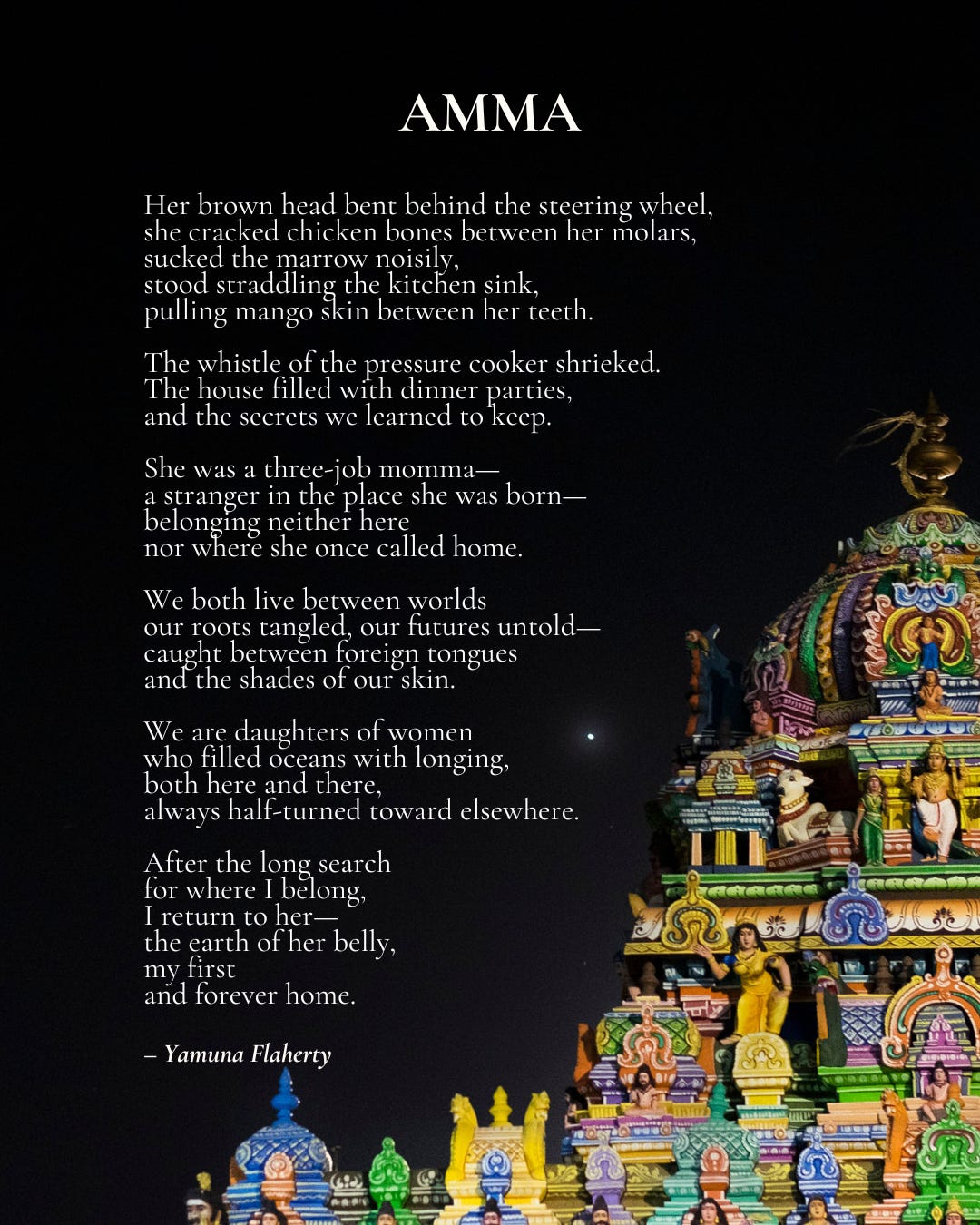
Below, I am sharing a poem from my collection, Hips Like Holy Rivers.

THE LONG ROAD LIBRARY
Movie recommendation: Girls Will Be Girls
I don’t think I’ve seen a better movie in a long time. A complex relationship between mother and daughter, set in the Indian Himalayas at a boarding school where 16-year-old Mira experiences a sexual awakening with a new classmate that turns her world upside down. In this coming-of-age film, the complex characters, layered relationships, and pressures of girlhood and motherhood are so exquisitely portrayed in this award winning movie.
Have you ever heard of the streaming platform Kanopy? For members of participating libraries in various countries around the world, you can watch a high quality curated library of films that are often behind paywalls elsewhere. All you need is a library card to use this service. Check out Girls Will Be Girls, available for free on Kanopy.
Happy Mother’s Day to all the women out their raising babies, dogs, birthing projects, dreams, and building the new world we all pray for.
Love Yamuna x
Beautiful!
Very beautiful...
I too from immigrant stories, though both European. WW2 story. My Polish father was 21 with a child, my sister, and not finished university in England but married to do the 'noble' thing. (I learned later) No romance. An obligation after an encounter with a woman incapable of love for children, including her own.
Grandparents and other family were far away in England and letters were the only connection.
What I come to see in my life after reading this and other of your writings is that I connect to neither parents nor lineage.
Lineage is mysterious to me. And it may be for many others.
Each place I live, usually a long time, becomes home while I am there, but my personal queries are outside of family and culture and the past.
Interesting.