

Well Endowed
On the body I judged, and the slow work of learning to love it

On a recent beach outing, a friend and I fell into a familiar conversation—comparing our breasts, naming what we disliked, imagining what we wished we had instead. It felt like the prompt from the Universe to share this piece of writing. Its’s been in a folder for awhile. I’ve been afraid of being this honest. But this one feels like it belongs in the open—like something many of us have carried, quietly, for far too long.
I have spent my entire life hating my breasts.
The left one hangs, deflated, like a punctured tire. The right one tries to raise itself skyward, tentatively.
Both are equally unsure of themselves.
A pair of odd socks.
In a sea of perfectly placed nipples, my breasts seem confused, lacking in a confident direction. I have tried to remember better days when perhaps they were more equal in measure, glowing with youth and not yet rejected by eyes that have seen a better set.
In the bedroom, I have resorted to lying on my back, worried that if I sat up, my pathetic breasts would crumple and fold like a stack of cards or sway like fishing nets heavy with their catch. I know my wares have likely disappointed those pleasure-seekers of perfection, sizing my melons against the magazine models whose nipples are always facing the right direction. But mostly, I have disappointed myself.
Sometimes, I glimpse the enormity of my blessings that these used-up tea bags are fixed to my chest to feed many children. I wish they looked like I hadn’t just spent a decade doing that already. But as much as I have hated my breasts, I have seen better and worse fixed to women who don’t seem to give a hooter.
Here are some of the impactful “breast” experiences I have had:
ONE
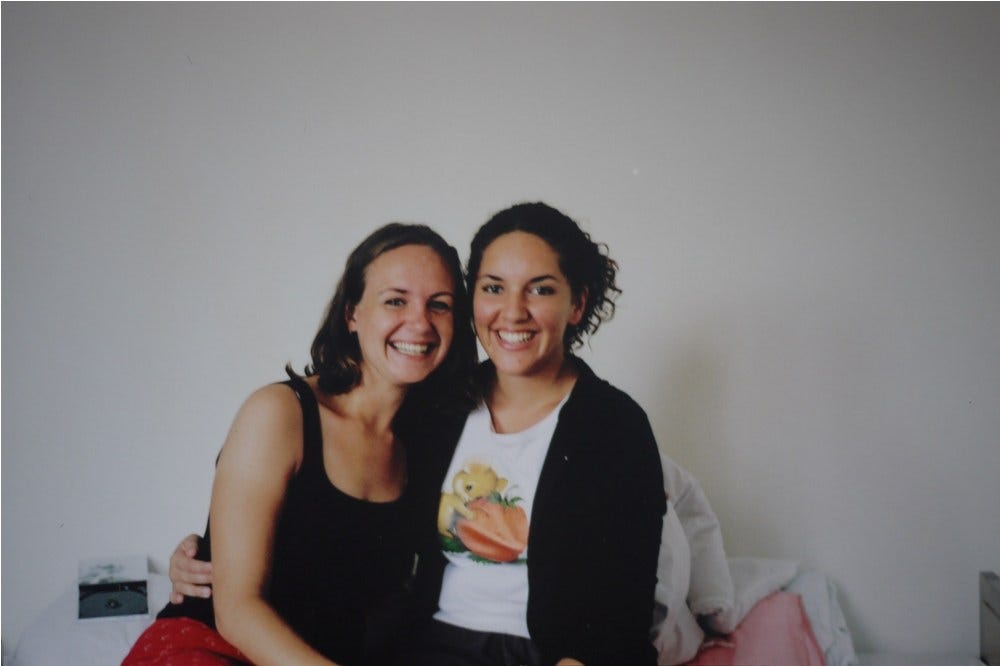
The first time I saw my best friend naked was two months into our backpacking trip in Lombok, Indonesia. She stood before me, her batik sarong wrapped around her.
“I want you to see me naked,” she said.
Since we were thirteen, we had masked our embarrassment with polite courtesy, turning away when we changed. Only when we met Europeans did we realize how unnecessary it all was. Planning to travel for a year together, it was time to drop our embarrassment.
That night, in a dim beach bungalow, I sat waiting by candlelight. The sea fizzed in the background.
“Ok, I am ready,” she said.
I held my breath, eyes down.
In one brave sweep, the flimsy cloth fell to her ankles.
She stood radiant, more beautiful than I imagined—supple breasts, perfect nipples, elegant hips. Our laughter cut through the tension.
“You are beautiful,” I whispered.
We both started laughing. Then crying. Then laughing again.
TWO
Years later, I travelled to a forest in Slovakia for the World Rainbow Gathering—a counterculture movement where thousands congregate in temporary villages built on a sharing economy.
Nudity was common and unremarkable.
Each day, I stood naked with others at the communal showers, waiting for my turn for a one minute rinse under the hose with an audience. The Rainbow was a place that encouraged me to let go of body shame and witness how many kinds of bodies there are.
There were women with round, taut breasts and thick thighs marked with cellulite. Men, built like Poseidon, with tiny penises. Perfection was rare, no matter what Hollywood has implied. There was one man who looked the part—hair like Fabio, body like marble, perfect penis—who wandered through wildflowers with a wooden staff. Like c’mon. I walked behind him a few times, captivated by his flexing butt muscles.
And there was that women who had the most unforgettable breasts of my life.
She sat across from me at a Tantra workshop, a pixie-like woman, porcelain features, children at her both her sides and one strapped to her chest. She sat and unwrapped her shawl, uncaringly revealing breasts that I would have gone to the ends of the earth to hide. Her boobs were so flattened, so utterly empty, they hung long and low like knee-length socks, her giant pink nipples grazing her thin waist. The rest of her was so exquisite that her breasts defied logic. What stood out even more was her posture—how straight, how unashamed she was in front of strangers. Hers chest made mine look like a model’s, and yet my shame stopped me from embracing my own body. In the circle, she spoke with confidence, her accent distinct. She was from Poland—a radiant woman with tits that didn’t astonish me as much as her self-assurance.
THREE
I once found myself in the epicentre of where the 1980’s famine struck the Ethiopian Highlands.
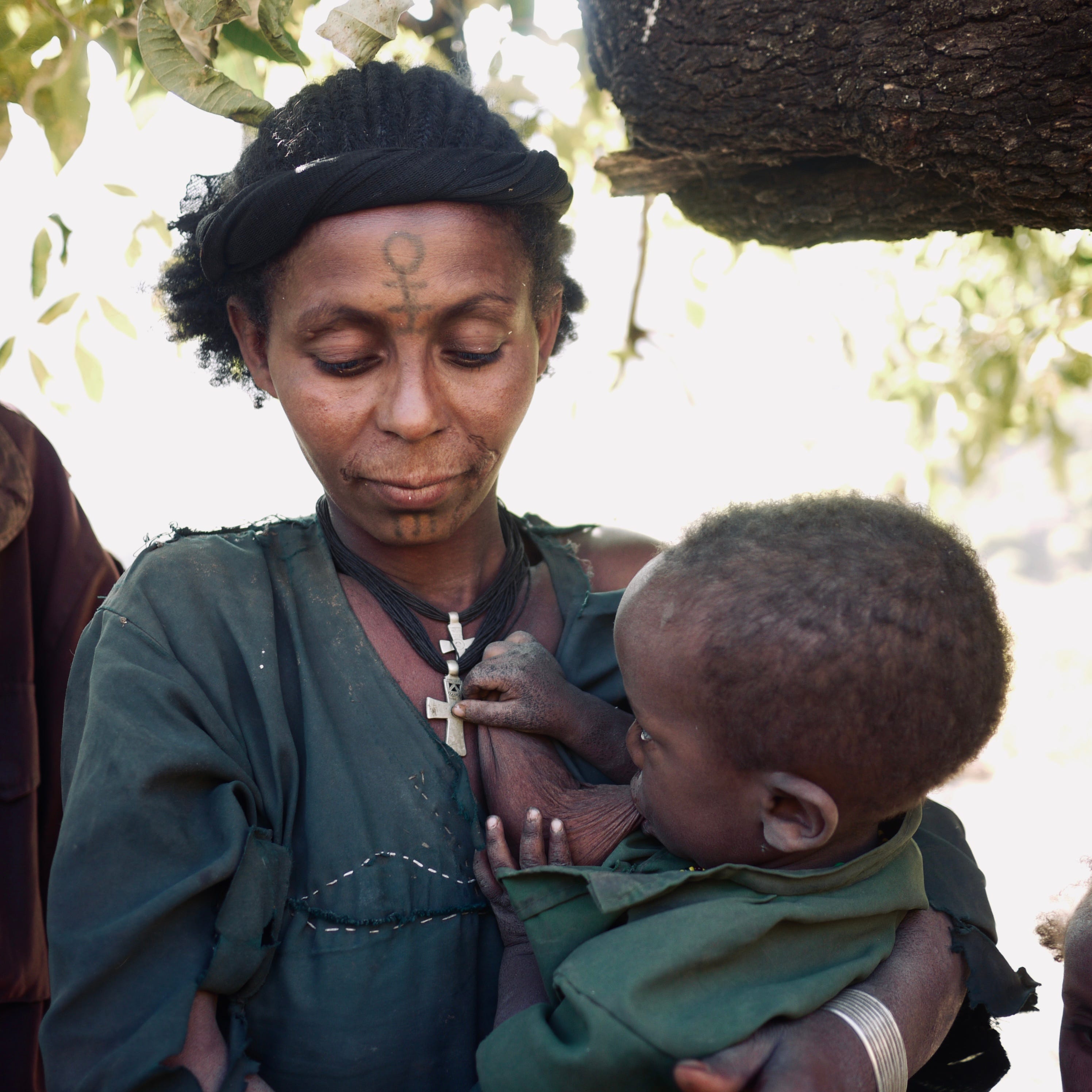
The scorched earth was still dry and unforgiving. Everywhere, women balanced water jugs on their heads and snotty-nosed kids on their hips, always with a chewed-up breast hanging out of a hole in their blouse.
Breasts in those parts were as drought-stricken as the land, stretched like leather, nipples left long and shaped to the roof of a baby’s mouth. The women seemed utterly oblivious to the fact that their breasts would be considered embarrassing in my culture and would likely never see the light of day without being stuffed with silicone.
Did the women here feel the same way about their breasts that I felt about mine?
My vanity embarrassed me.
I have lost track of how many hours I have spent contemplating a breast enhancement. Bra shopping used to send me into weeks of post-shopping depression. Every time I had a new lover, I wrestled with the feeling of dread that -klsat in the pit of my stomach for the moment I would take my shirt off and look into their eyes for their opinion.
Here, in one of the poorest and most beautiful places on earth, none of it mattered.
How had I let the superficial world with its impossible beauty standards define my breasts and, ultimately, how I felt about myself?
FOUR
One of the last times I saw my grandmother in South India, we sat on a rice mat. She was wrapped in a sari, no longer able to walk properly because of a broken hip. Her thin blouse covered her wrinkled chest. Without warning, she lifted her blouse to expose a pus-filled sore on her left breast. She clicked her tongue the way Tamil women do—a mournful sound. We never named it, but I wondered if it was cancer.
Years later, my aunt lost a breast to the same disease. Life continued, but I began to worry about breast cancer too—from genes, or from how much time I’d spent hating on my breasts. During an Ayahuasca ceremony, I received the message that I had let my breasts be drained of their life force in hopes that someone else would love me more than I loved myself.
It was time for something to change.
FIVE
At forty-one, I gave birth to my daughter.
As my breasts swelled with my belly and my nipples darkened, my understanding grew with my child: breasts were no longer just things to attract—they existed to sustain my baby’s life. They were source. A function. A lifeline.
For the first time, I loved my breasts in a whole new way. Until I breastfed.
I didn’t expect breastfeeding to be such a horrendously painful affair. Maybe my nipples were too flat, or the latch was wrong, or I didn’t get enough milk, or perhaps I had tubular breasts without enough glands to produce milk. Once again, my breasts just couldn’t get it right.
And yet, something slowly shifted anyway.
When you become a mother, life becomes less about the love you wish to receive through things as superficial as one’s breasts and more about the devotion to the life you have created.
In my daughter’s eyes, I am beautiful. She tells me so when I put on a dress, and she pets me, saying, “Nice.” Sometimes, she pokes my boobs and giggles, curious and unashamed. I love seeing the world through her eyes, eyes that haven’t been taught what is desirable or lacking. Eyes that just see me.
I wish I could time-travel and tell my twelve-year-old self to love her body fiercely, no matter what anyone tells her is beautiful or not.
I wish I could show up before her tiny chest is sexualized so that she could know all the goodness God endowed her with in those two perfect breasts.
But I can’t go back.
I can only go forward.
I can guide my little girl toward loving her body just the way it was made.
I can appreciate my wrung-dry, crumpled-up old lady breasts.
And if I’m lucky, I can be a granny with one of those big ‘ol chests that wee grandkids lay their heads on and fall asleep.
It might take my whole lifetime.
To stop measuring them.
To stop apologizing.
To stop looking for proof in other people’s eyes.
But I am beginning to understand—
I have always been well endowed.

Journal Prompt: If you could speak to your younger self, before she learned what was “beautiful,” what would you tell her about her body?
MORE LIKE THIS


I’m crying dude! I went through my own journey with hating my boobs; wanting a boob job at 25. It also took a bunch of ayahuasca ceremonies for me to come to love every inch of my body. Some days are easier than others, but the peace remains the same.
I tell my younger self all the time, “You are beautiful, so strong, and unique. You are going to go through the most beautiful process of falling in love with yourself and I’m so excited for you baby.”
I love you so much for your vulnerability.
I would tell her "your body is wise beyond words and you will learn to inhabit it with love, honour and respect. To listen. To love it."